Travel has a wonderful way of opening your eyes — not just to breathtaking landscapes and extraordinary people, but to the uncomfortable, complicated, messy reality of how the world actually works.
Our trip into another part of Sahara desert was all of those things at once. Plus sand. So. Much. Sand.
The magic first — because there was SO much of it.
We were suddenly an accidental United Nations on wheels: English, French, Argentinian, Spanish, Colombian, German, Italian, Chinese, Hungarian……. and one of our absolute favourites, a young woman who turned out to be an orphan from Guangzhou, adopted by a warm-hearted Spanish family. Her Spanish mother had simply seen the news about China’s orphan crisis, booked a flight, and gone to bring a child home to Spain. We were deeply touched. The world can be a rather wonderful place when people decide to act on their empathy.
Our Hungarian companion generously shared whisky from a licensed shop — because yes, you can drink alcohol in the middle of the Sahara, even in a Muslim country, and nobody was more delighted by this discovery than our group. The friendly Italian, meanwhile, handed out his personal mobile number to everyone and insisted — demanded, really — that we all come and visit him in Italy. We are genuinely considering it.
The conversations! The laughter! This is why travelling long distance with a random international group of strangers can be one of life’s great underrated pleasures. You arrive as individuals and leave as a slightly chaotic, whisky-warmed extended family.
And our lovely guide Aissa filled the long drive with the most incredible Amazigh music — joyful, raw, free spirited — and I am still listening to it now, writing this.
But then came the part that stayed with us long after the sand had left our shoes.
Every single person in our touring group had booked through Get Your Guide. On the way to the desert, Aissa let slip something that made us all go rather quiet. Get Your Guide had taken a 35% commission from every fare we’d paid. He said they didn’t pay tax to Morocco. The platform sitting on a server somewhere had pocketed more than a third of the money before the desert had even come into view. Meanwhile, Aissa had been working seven days a week for months, with August as his only break.
And that was only the beginning.
Around the campfire that night — sparks drifting up into a sky so full of stars it felt almost theatrical —the camp attendant worked hard to set the mood, singing heartily and drumming up a lively atmosphere. During the break, I asked what he prayed for during Ramadan. He paused, gazed into the flames, and said quietly: “Life is life.” Three words. We sat with that. Then he grinned and added that on his current wage, he couldn’t afford to have a wife anyway and he was getting old—He laughed. And then we all went a bit quiet again, nobody quite knew what to say.
Late that night, on the way to the facilities in the dark, we stumbled upon something shocking: our guide Aissa was sleeping outside on a bench, bundled under three layers of blankets in the biting desert cold. We later learned this was standard practice at this camp — tour guides get no room. Even in winter, they wrap themselves under five layers and sleep in the open air while their clients are tucked up inside the tents. And it wasn’t just Aissa. To our surprise, we discovered that the employees at both riads where we stayed in Marrakesh had no private bedrooms either — just a bench, all night, every night.
Here’s the other side of tourism, though.
One Argentine lady in our group had tried booking directly with a local operator. They quoted her 30% more than the identical package listed on Get Your Guide — and their website showed no prices at all. Online reviews told a mixed story — including repeated complaints about tour guides steering tourists toward overpriced restaurants serving mediocre food during lunch stops. So when trust is low, risk is high, time in the country is short and the budget is tight, she did what almost everyone does: she voted with her feet and opened the app. I don’t think I could fault her for it. She told me she might have booked with the local company, if they had dropped their prices to the same price from Get Your Guide. This is the side of tourism nobody puts on the brochure. It’s uncomfortable and it deserves more than a shrug.
The same thing happened at a social enterprise selling handmade goods to support local women — a cause we’d have loved to get behind. No price tags anywhere. When we asked, the quote started at four times the price of the same product in a nearby supermarket where locals shop. And the price changed every time when I asked. I understand that haggling is woven into the local culture, and I respect that, but somehow I felt perhaps a social cause should have done things a bit more differently.
Trust, it turns out, is not a soft currency —it’s the thing most other things depend on. A lack of trust can turn a potentially great cause into an exhausting mind game, especially in an industry where trust is vital.
I have plenty of my own blind spots and contradictions — more than I’d like to admit and more than I can even see. I’m not here to point fingers. I’m here simply to name what I observed, sit with the discomfort it left behind, and resist the urge to wrap things up in a tidy conclusion.
The final day 🙏
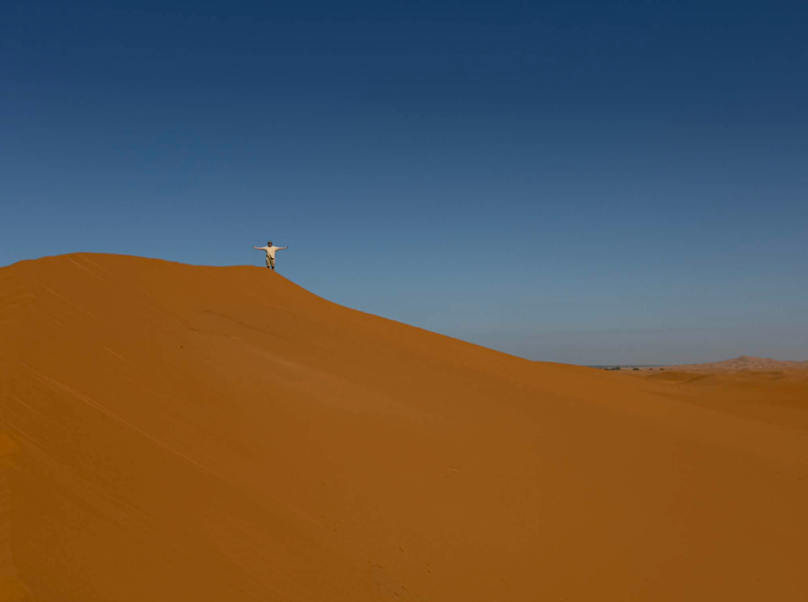
We were the only two people who booked to do an extra day. Everyone else returned to Marrakesh including Aissa. At early morning, we climbed to the top of the dunes as the sun began its slow, golden descent. We sat down and opened the Lectio 365 app, letting the desert fathers’ prayers wash over us — voices carrying centuries of stillness into that dramatic landscape, that vast and wordless void. It was transcendent. It was beautiful. It was, without question, the best two hours of our entire trip.
And then came the worst 4 hours of our trip, an obligatory whistle-stop tour of four different sites in quick succession, and — we’ll be honest — we loathed every second of it. Tick, tick, tick, snap, snap, snap — which we endured with the quiet dignity of two people who had absolutely chosen this and had no one to blame but themselves. Somewhere deep inside, a small voice grew louder: you should have stayed with that lovely Amazigh family you met last time in the desert — slowed down, stopped performing travel, and actually breathed……
So, if we had a magic wand?
We’d love to take our parents travelling before they become too old. And in the meantime, we’d love to build something that tells the stories of different communities, something that connects curious, conscious travellers directly with the local communities who make a place extraordinary. Something that empowers them with the AI skill they need to improve their living. Something that cuts out the platforms swallowing colossal commissions. Something that provides guides like Aissa a proper room with a proper bed. Something that makes booking locally as easy and transparent as clicking a button on an app……
We don’t have a magic wand. We’re still figuring out how to shoot and edit a travel video without it looking like a documentary filmed by a golden retriever. But hey, I firmly believe where there is a will, there is a way! And how we spend our money when we travel matters. Our purchase is a small vote for the kind of world we want to live in. And the more of us who vote thoughtfully, the louder that becomes.